EXPLOITATION, TRAFFICKING: Coalition Urges Action

Men Ending Trafficking Men Ending Trafficking (Toronto) and EmpowerMen (Winnipeg) co-sponsored a series of events on Parliament Hill last week to recognize and discusses the Protection of Communities and Exploited Persons Act (PCEPA 2014). The endeavor was centered around the idea that every Senator and Member of Parliament should own a copy of the powerful new book, “WHEN MEN BUY SEX: Who Really Pays?” by Heinz & King. And so, on the 11th anniversary of PCEPA, we delivered 448 individually addressed copies of book to our nation’s capital!
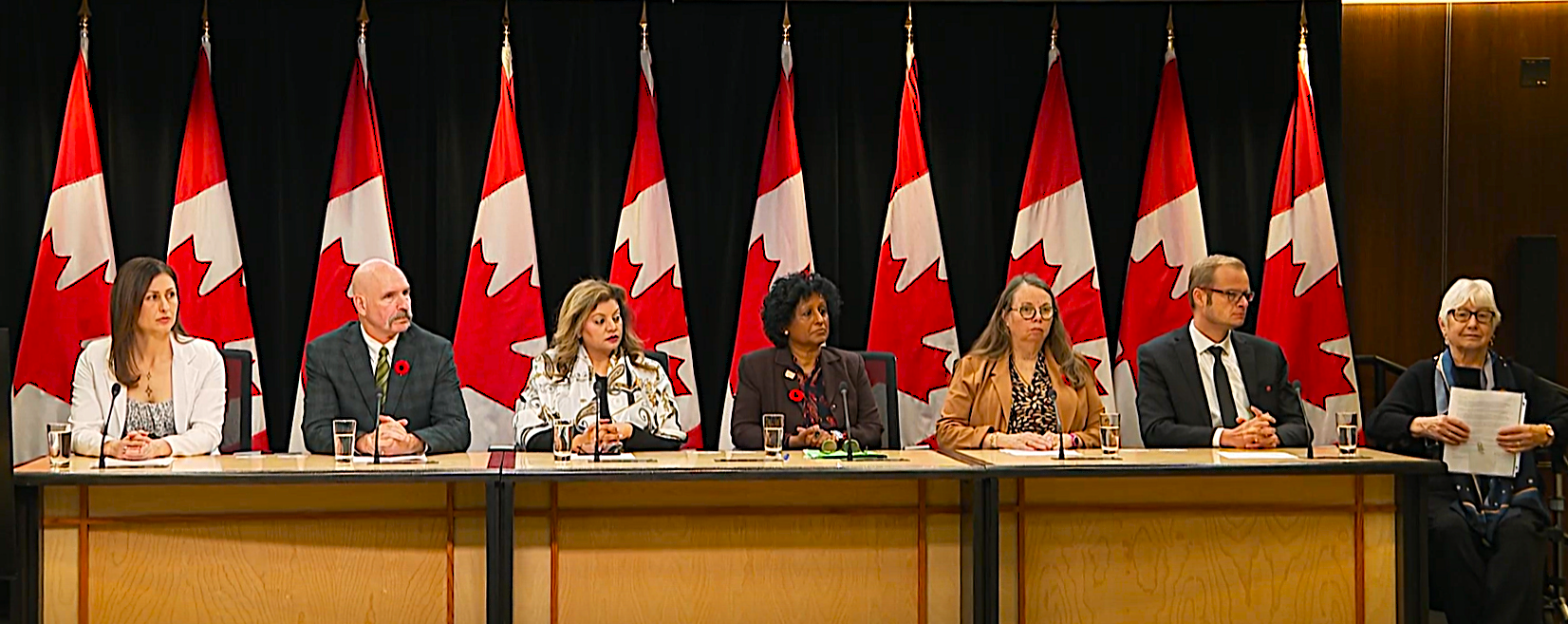
We were hosted by MP Arnold Viersen and Senator Julie Miville-Dechêne, and joined by an impressive team of advocates lead by co-authors Andrea Heinz and Kathy King. Last Thursday, before departing Ottawa, we gathered for a parliamentary press conference. Below is my statement.  

Press Statement, John Cassells, November 6, 2025

My name is John Cassells. I am the Founder and Board Chair of Men Ending Trafficking, a charitable advocacy organization based in the Toronto Area. Also, in my full-time role with SIM Canada, I am the Director of an agency called Lifeworthy. In addition to assisting young women exiting the sex industry, we provide support and guidance for parents of adult and minor-aged children who are actively being exploited.

The year was 2014 when Justice Minister, Peter MacKay signaled that the Government of Canada had come to a new understanding on the concern of prostitution; that it is profoundly harmful and inherently exploitative. He had searched for a legal framework to lower the risk to those in prostitution and found none. The clear path, then, was to discourage, wholesale, the prostitution industry. That would largely be accomplished by deterring the purchase of sexual services.  

Click to watch John speaking at the parliamentary press conference.

MacKay placed a robust legal scheme on the table: The Protection of Communities and Exploited Persons Act or PCEPA. Prostitution, which had been historically passed off as a mere public nuisance, would be more appropriately be reframed as a crime of exploitation.

I regret to tell you that Canada’s 2014 anti-prostitution law was neither appropriately implemented nor enforced in the provinces and territories, and prostitution activities continue to be licensed by our cities. Even some politicians elected to look out for the wellbeing of their own communities remained in opposition to PCEPA. In the House of Commons, we heard it argued that “Sex work is work.”

Which is it? Is prostitution a viable career option or is it a form of exploitation? The dozens of parents in Lifeworthy’s parents’ program will answer the question without hesitation. They will tell you about the radical changes in the behaviour of their children and the loss of relationship they experienced. They will speak about the violence perpetrated against their daughters and describe the injuries to their bodies. They will testify to the deteriorating mental and physical health of their daughters and lament over the addictions that took hold from efforts to self-medicate. Many will share that the nightmare continues without relief or closure. Some, who have received closure, will tell you about the anguish of having to bury a daughter. These are some of the people who are most qualified to tell you what happens when men buy sex.     

In conclusion, I’ll quote from the book, When Men Buy Sex, Who Really Pays, by Andrea Heinz and Kathy King (Page 165)  “…condemnation of sex trafficking is an important first step, but distinct hypocrisy prevails if we do not address the underlying issue of consumer demand.”

Click for link to a CPAC recording of the full press conference.
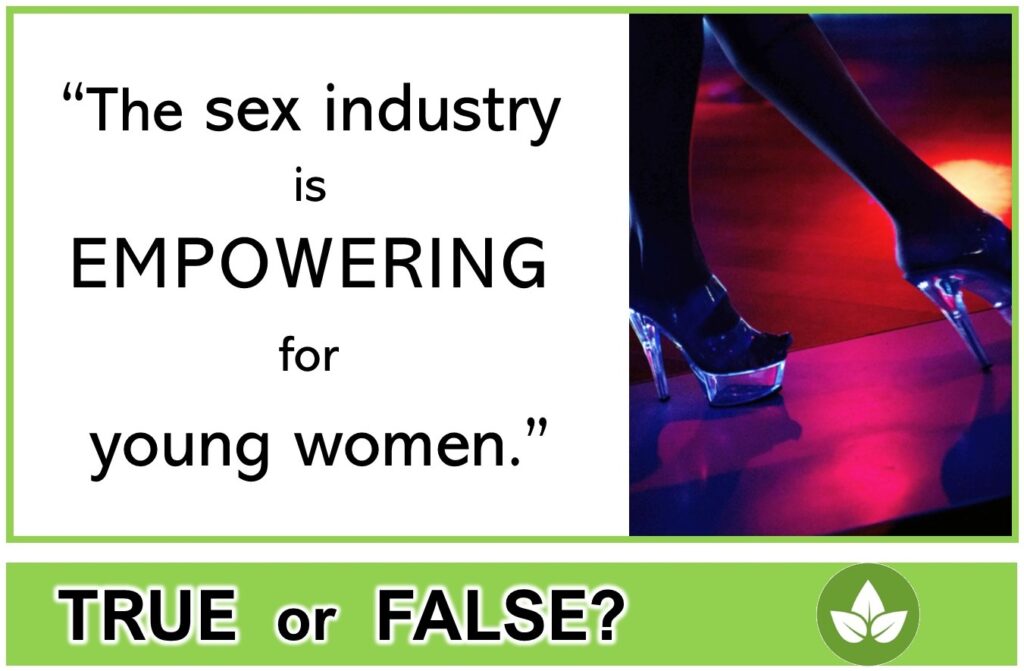
How Empowering is the Sex Industry?


The World Day Against Trafficking in Persons is July 30th, 2021 and is a project of the United Nations. But the global super giant has been pushing countries toward legal “sex work” for years. Increasingly permissive attitudes toward activities like stripping, sex camming and escorting are contributing to a devastating rise in human trafficking and other harms associated with the Canadian sex industry. Our promise to you is that we will continue to tell you what we are seeing.

For more information about Lifeworthy, visit www.lifeworthy.ca.

Article Supports Pimps & Johns

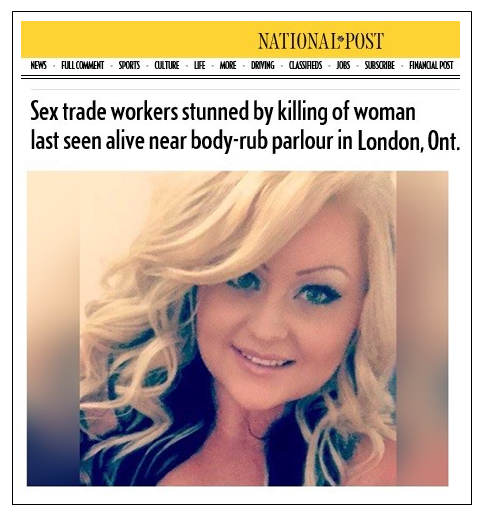
Re: Sex trade workers stunned by killing, Oct. 31st 2017, The National Post.

Josie NatPostAs an advocate for exploited girls and women, I was deeply saddened to read about the recent killing of London’s Josie Glenn; and more so, because reports suggest she was a victim of sex industry violence. Because exploited women are so often overlooked, I appreciate The National Post shining the spotlight on this tragedy. At the same time, I’m deeply concerned that the article gives voice to an organization whose efforts may, in fact, endanger women like Glenn.

The London Free Press, which originally published the story, offered a soap box to one activist on a nihilistic rant, saying “Sex work isn’t what harmed Josie. It was . . . laws/by-laws that make it less safe…Efforts to speak for or de-legitimize sex work continuously puts workers in danger.” The Post, then, amplified the fable, by running the article hours later.

We did, in fact, have some old prostitution laws that arguably created danger in isolated circumstances. But in 2013, those were struck down by the Supreme Court in a challenge called Bedford vs Canada. The man behind the crusade, law professor Alan Young, admitted under oath that unrestricted prostitution doesn’t work, based on the evidence from countries that have tried it. His contention was that Canada’s response to prostitution had been sloppy. The court agreed, and within the year, we came out ahead with laws to reasonably address the harms suffered by this vulnerable segment of society. The cornerstone of the legislation makes it illegal to purchase sexual services. Along with that, is a measured leniency for the providers of sexual services, given that the sex industry is rife with exploitation.

The then, Justice Minister, Peter Mackay, called it a uniquely Canadian approach, but it closely harkens to the so-called Nordic Model that was first adopted by Sweden in 1999. The approach has been strongly credited with not only reducing prostitution, but the rates of sex industry violence and human trafficking, as well.  In spite of that, the Canadian legislation wasn’t so popular across party lines. While the Trudeau Liberals have, so far, done little more than sniff at it, Ontario’s Premier lead an attack on it following its 2014 enactment.  But she later backed off after her own Attorney General verified it’s alignment with our Charter of Rights and Freedoms.

The media hasn’t been helpful, either. Instead of representing the issue with any kind of objectivity, most outlets daftly promote the same pro-prostitution rhetoric that led to increased crime and violence in places like Germany and the Netherlands.  The only ones who stand to benefit are pimps and johns.

If we’re going to be truly honest about why women and children are being harmed in the sex industry, it’s happening in spite of our upgraded laws. The harm happens because the perpetrators of the violence, the sex buyers, are rarely met with more than a nudge and a wink. Sadly, our society has remained unconcerned for the health and safety of girls and women on the margins.  If that were not the case, enforcement would  have already crippled the industry, and Josie Glenn would likely be alive today.

A Brotherhood Born In Pain

I studied the four men who sat across from me. With somber faces and heavy hearts each took a turn to speak.  Any one of their stories was a lot to process; complex and convoluted.  Their emotions were raw and their pain unimaginable.  Each expressed the horror that only a parent can know when his daughter is exploited by the sex industry.  While no two stories were identical, a certain brotherhood was beginning to emerge, the kind that develops between those who share similar pain.

There were also women in the circle, mothers who were losing daughters to this evil.  Tonight was the first time they didn’t outnumber the men in the group.  I had not expected this, because commercial sexual exploitation is a crime that usually befalls fatherless girls.  But here was a reminder of the pervasiveness of this dark industry’s tentacles.

I sat back in my chair, not knowing what to say.  For the moment, it seemed that saying nothing was the best response.  This was the stuff of which third world documentaries are made:  films of far-away places like Cambodia, perhaps, or the Philippines.  Our society has come to uncomfortably accept that these abuses have deep roots in poverty-ridden countries, war zones, or at least places that don’t share our Christian heritage.  But the parents at this meeting represented the countless other Canadian families that face such tragedy in relative isolation, shame and despair.    

It was just over a year ago, that parents J & L approached me with their “Parents Hope” vision.  They saw the need for a support group for parents impacted by the sex trafficking of their child.  I had never heard of this kind of group before, but had already been providing individual support for a few parents who I thought might be interested.  After discussing and developing our approach, and networking with other agencies, we began monthly support group meetings in May 2016, at SIM’s national headquarters in Toronto.

Pastoral care, peer support, education and prayer summarizes the Parents Hope approach.  We also work individually with families to help bring an end to the exploitation and encourage the healing of relationships.  While the group continues to gather momentum and its full impact is yet to be determined, the depth of gratitude already shown by more than a dozen parents confirms that Parents Hope is making a difference.

For more information about Parents Hope, please email parentshope22@gmail.com

Righteous Anger

“People do all sorts of things for money,” she says. “I would like to see lawmakers looking through the lens that there’s nothing morally wrong with providing sexual services for money.”

Body Rubber ScrShot

I became angry after reading, in my community news paper, all about prostitution’s therapeutic benefits to local men, and the wonderful career opportunities it provides for our daughters.  And I felt like saying something.

Letter To The Editor, Metroland News, York Region

Local massage parlour luring young women with the same false promises that violent pimps use.

Local massage parlour luring young women with the same false promises that violent pimps use.

“…Onyx Ronin, the alter ego of the woman Mr. Grimaldi interviewed, suggests it’s right and fitting that men should be able to buy access to women’s bodies.  Ronin calls it “selling intimacy” and would have us believe that she receives nothing but respect from her clients.  In contrast, colleagues of mine who have been exploited in local massage parlours tell seemingly endless stories of violence, addictions and human trafficking.  Like Ronin, my friends staunchly defended prostitution, when they were trapped in it.  Only after distancing themselves from the exploitation, and beginning the healing process, were they able to speak about the abuse.       

Ronin’s attempt at advocacy for body rubbers is overshadowed by a bid for her own validation from law makers.  The story sends out a confusing message and ultimately affirms the men who indulge in an illegal industry that opposes Canadian values.”

-John Cassells, Street Youth and Human Trafficking Specialist, SIM Canada

Please Click Here to read my full letter, and Here to read the original article.